

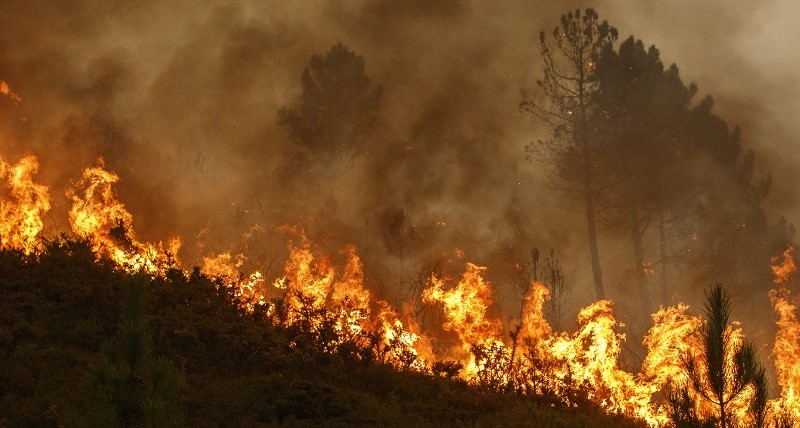
Wildfires have become an increasingly prevalent peril worldwide. Summer 2026 has been exceptionally hot and dry in Europe, following a wet winter in the United Kingdom, France and Spain, promoting wildfire weather conditions.
While it is still too early to estimate the overall insured loss with confidence for the wildfires in Spain and France, both countries saw significant burn areas (in July, more than 900 square kilometers in Spain; more than 500 square kilometers in France, far exceeding the record for previous years since 2006). However, burnt area does not always translate to insured losses.
It will take time to understand the full extent of both the physical damage and the broader business impacts. What is already clear is that wildfire losses extend well beyond property damage. Evacuations, operational disruption, site closures, and supply-chain impacts have been commonplace – all of which carry significant financial consequences.
One of the growing challenges is non-damage business interruption — situations where a business cannot operate because of a nearby wildfire, smoke damage, or a government evacuation order, even though its own premises were not physically damaged.
In Greece, for example, some of the most significant corporate wildfire losses in recent years have affected hotels and smaller businesses, while industrial property has been less exposed because many facilities are in dedicated industrial zones. Many traditional policies either exclude non-damage business interruption or offer only limited coverage, so businesses are increasingly seeking specialised endorsements. This creates an opportunity for a strategic shift in risk management, i.e. companies that invest in resilience — such as redundant suppliers, stronger continuity planning, fire-resistant construction, and vegetation management — may be able to negotiate more favorable insurance terms than competitors with similar physical exposures but weaker contingency planning.
Beyond physical damage
The wider picture also highlights Europe’s wildfire protection gap. Spain’s 2025 wildfire season generated close to €5 billion in economic losses, but well under €1 billion was insured. This highlights the growing gap between economic and insured losses and reinforces the need for organizations to combine effective risk transfer with investments in resilience, adaptation and business continuity.
The evidence suggests wildfire risk is evolving rather than representing a one-off event. Longer fire seasons, prolonged summertime drought, and expanding development at the wildland-urban interface are increasing both the frequency and complexity of wildfire risk.
At the same time, emerging perils, such as wildfire, represent a growing share of catastrophe losses and are becoming a much greater focus for insurers and reinsurers. As a result, wildfire is becoming an enterprise risk issue that extends well beyond the insurance market.
For businesses, this means shifting the conversation from responding to individual events toward building long-term physical resilience and operational readiness (business continuity, evacuation planning, supplier mapping). In Europe, we may see wildfire risk financing evolve along two tracks in the coming years.
First, insurers, public entities and large corporates may increasingly access capital-markets capacity through insurance-linked securities, including catastrophe bonds, to support peak wildfire aggregates and reduce reliance on constrained reinsurance.
Second, we may anticipate growth in parametric wildfire solutions designed around measurable triggers — such as burned area, fire intensity indices, evacuation orders or air-quality thresholds — to deliver rapid financing for response costs and revenue disruption, particularly where losses occur without direct physical damage.
The objective behind parametrics is not to replace traditional insurance, but to combine strong risk management, insurance, and innovative risk financing into a more resilient overall strategy.
Financing a changing risk
The key enabler is robust risk quantification. While wildfire modeling in Europe is growing rapidly, California is much more mature in terms of effective use of these tools. As modeling continues to improve, alongside more sophisticated multi-peril risk analytics, insurers and investors will be better able to assess accumulation risk and develop innovative risk transfer solutions.
At Marsh Re, we offer our Global GCAT™ Risk Rating that can help quantify location-level wildfire risk, along with Sentrisk, Marsh’s AI-powered supply chain risk management platform. Together, these tools power client decision-making at speed.