Risks
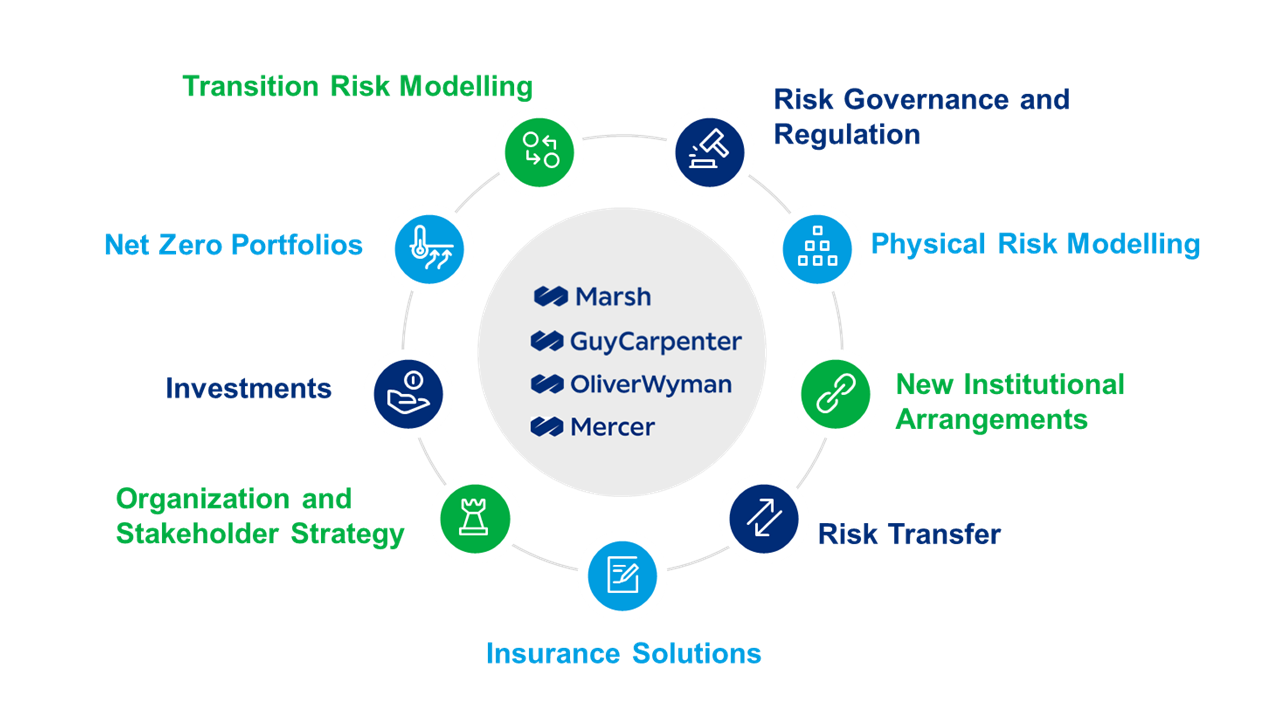
Guy Carpenter’s Climate offering brings you an integrated range of services designed to address multiple facets of physical risks related to climate change, while leveraging the power of other Marsh businesses to also tackle all aspects of risk.
At the end of 2024, global insured catastrophe losses exceeded $100 billion for the fifth year in a row. An evolving physical risk landscape coupled with population increases in more prone regions has required insurers to become significantly more sophisticated in their approaches to understanding catastrophe risk.
Companies developing and integrating robust climate change strategies into their risk management can benefit from the comprehensive offering at Guy Carpenter and across the Marsh enterprise. Our suite of climate advisory and modeling services supports insurers overcome the uncertainty of a changing climate and balance risks with opportunities in the near, medium, and long-term time horizons.

As the insurance industry adapts from educating to quantifying climate change outcomes, Guy Carpenter has released a suite of climate change products. These are available to aid in regulatory responses, industry benchmarking, underwriting strategies and risk management decisions.
In addition, Guy Carpenter offers a number of proprietary US hazard scores in present and future climate:
Guy Carpenter’s county-based risk score offers a holistic view of US severe convective storm (SCS) events. The SCS future climate risk score leverages the recent trends in environmental conditions conducive to tornado, hail, and extreme wind events to project future SCS risk.
The climate-adjusted wildfire risk score provides a comprehensive view of wildfire risk and helps clients quantify risk across multiple levels, including risk selection, rate-making and strategic growth. The climate-adjusted wildfire risk score leverages downscaled climate models to project future risk at multiple time slices and emissions scenarios.
Guy Carpenter’s proprietary United States and Caribbean Sea Level Rise Risk Score offers a transparent approach to modelling rising sea levels. To better understand which locations are at the highest risk of coastal flooding in the future, multiple time horizons and emissions scenarios are considered.
Guy Carpenter’s climate-adjusted Tropical Cyclone Risk Score combines several complex datasets using a transparent methodology, providing clients with a high resolution, model agnostic view of wind risk from tropical cyclones for multiple emission scenarios, ensemble metrics, and time slices.
Our Guy Carpenter climate change tools enable clients to quantify the physical impact of climate change on their modelled losses, based on scientific insight. This supports regulatory requirements, reinsurance and underwriting decisions, and internal risk management strategies.
In the insurance context, physical risks are direct damage to insured assets by weather and climatic events. Climate change is increasingly influencing the frequency and severity of natural catastrophe perils, with physical climate risk exacerbating both acute and chronic threats.
Transitioning to a lower-carbon economy may entail extensive policy, legal, technology, and market changes to address mitigation and adaptation requirements related to climate change.
Working in tandem with Marsh Risk, Oliver Wyman, and Mercer, Guy Carpenter is also able to provide services that span several other climate-related areas. These services include transition risk modeling, climate investment portfolio modeling, asset-level resilience surveys and scoring, supply chain modelling and commercial due diligence.
By applying a combination of modeling techniques, proprietary risk assessments and the latest in scientific research, you can prioritize your climate-related activities, while also benchmarking the success of your approach against industry peers.
Guy Carpenter conducts an internal survey every year of all its brokers globally, to assess how climate change is impacting reinsurance renewal negotiations. We gathered almost 300 responses, with findings across different themes:
Survey results are collected annually to track the evolution of market expectations around climate change.