


October 30, 2026
Technology, the growing influence of alternative capital asset managers, and a softening market are reshaping the risk transfer value chain, challenging traditional roles and creating opportunities to build competitive advantages across the (re)insurance industry.
Traditional boundaries across the (re)insurance industry are becoming increasingly blurred. Brokers, insurers, reinsurers, and tail risks’ capital providers are expanding into new areas of the risk transfer value chain, creating new competitive dynamics and opportunities for collaboration and differentiation.
As these roles evolve, industry participants face important decisions about where to compete, which capabilities to invest in, and how to create lasting commercial value. At the same time, the pursuit of greater efficiency raises questions about the resilience of a system built to withstand periods of disruption.
New forces are changing how risk moves through the market
Three key forces are reshaping the risk transfer value chain:
1. Technology is expanding access and reducing friction. Advances in data analytics, automation, and digital platforms are changing how risk is assessed, priced, and transferred. They are improving access to information, enabling the development of new products, and allowing participants to perform activities that once depended on specialized intermediaries or established distribution channels. As businesses extend their reach across the value chain, technology is also challenging the advantages of established participants.
2. Alternative asset managers are moving deeper into the ecosystem. Their role extends beyond supplying capital through insurance-linked securities and reinsurance structures. Investments in managing general agents (MGAs), insurance platforms, and other businesses are giving these firms a presence across more parts of the value chain. They bring new capital, investment expertise, and approaches to structuring risk, while creating competitive overlap with traditional insurance and reinsurance participants.
3. A softening market is increasing the pressure to find new sources of profitability. As pricing and margins come under strain, established players have stronger incentives to expand their capabilities, explore adjacent businesses, and seek a greater share of the value generated across the risk transfer process.
Together, these forces are encouraging participants to expand beyond their established roles, creating new areas of competition and collaboration across the risk transfer value chain (Figure 1).
Figure 1. Traditional boundaries across the risk transfer value chain are blurring.
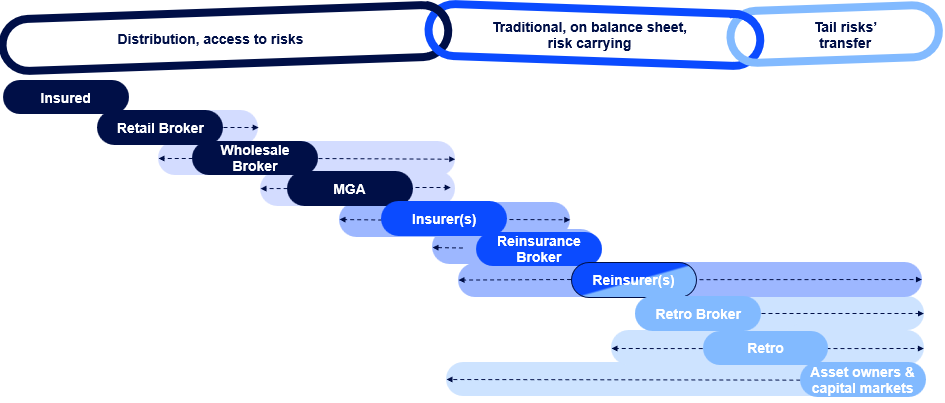
An important question is how much of this change is cyclical and how much is structural. A return to harder market conditions could temper some competitive pressures, but technological innovation and the growing presence of alternative asset managers may have more lasting implications for how the risk transfer value chain operates.
Competitive advantage will depend on where participants create distinctive value
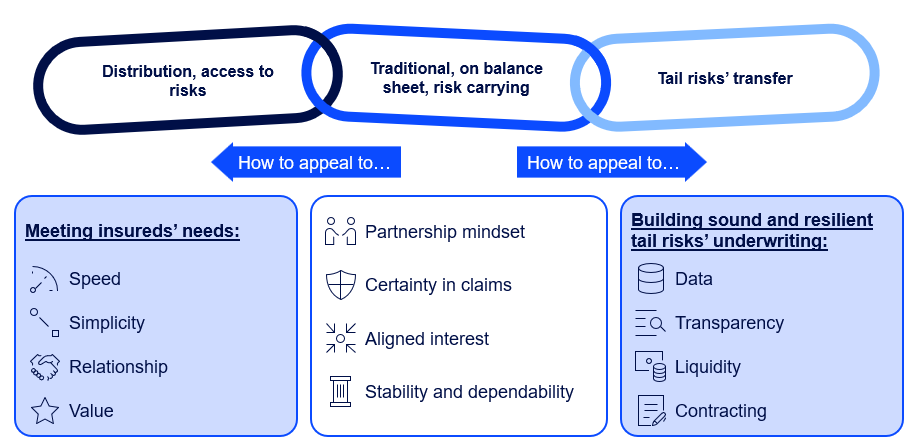
As participants move into new areas of the value chain, traditional sources of differentiation are coming under greater scrutiny. Capital, data, distribution, and specialized expertise have long helped define competitive positions. But access to some of these capabilities is expanding, making it increasingly important for businesses to understand which strengths truly distinguish them and which are becoming table stakes. (Figure 2).
For brokers, this may mean deepening their role as trusted advisers and solution architects, drawing on market intelligence, risk expertise, and the ability to connect clients with an increasingly diverse range of solutions.
For insurers and reinsurers, underwriting discipline, portfolio management, and financial strength remain important sources of value. Equally crucial is the ability to provide dependable capacity through market cycles. The disruption experienced during the January 2023 renewals underscored how much clients value continuity and certainty, particularly when capacity becomes constrained. As competition intensifies, insurers and reinsurers will need to demonstrate the value of that dependability alongside the price of the protection they provide.
Figure 2. The reshaping of the risk transfer chain creates opportunities for traditional risk carriers to differentiate themselves.
Alternative asset managers bring their own capabilities, including investment expertise, capital allocation, and the development of new structures for accessing insurance risk. Their growing presence creates opportunities for partnerships alongside competition for activities historically performed by established participants.
These changes are prompting businesses to examine where they should compete, where collaboration makes more sense, and which capabilities merit further investment. They also raise a question about monetization; possessing valuable data, expertise, or distribution does not automatically translate into commercial success. Participants must demonstrate how their capabilities improve outcomes for clients and counterparties, and how they can capture an appropriate share of the value created.
Greater efficiency could create a test of resilience
The changing value chain offers opportunities to make risk transfer more efficient. Technology can reduce friction and improve decision-making, while alternative capital structures can expand capacity and distribute risk across a broader range of investors. But greater efficiency also introduces questions about how the system will perform under stress.
Different forms of capital have different investment horizons, incentives, and responses to changing market conditions. Traditional insurance and reinsurance balance sheets generally provide committed capacity intended to support risks through market cycles. Alternative capital, while offering efficiency and flexibility, may be deployed across a much wider range of asset classes and can shift when returns become less attractive. This raises questions about how reliably different sources of capacity will remain available during periods of market stress.
These differences matter because the ability to transfer risk efficiently during favorable market conditions does not necessarily establish how effectively the system will absorb shocks during a crisis.
As the value chain becomes more interconnected, the consequences of individual business decisions may also extend further across the market. Participants pursuing more efficient capital structures, distribution models, or operating arrangements need to consider how those choices affect the resilience of the broader ecosystem. This is particularly relevant in a softening market, when competitive pressures can create incentives to prioritize near-term returns.
How participants respond will shape the future of (re)insurance
The convergence of technology, new capital sources, and changing market conditions is creating opportunities to rethink how risk is assessed, financed, and transferred. It is also challenging established assumptions about which participants are best positioned to deliver value.
For industry leaders, the implications are both strategic and commercial. Decisions about where to compete, which capabilities to develop, and when to collaborate will influence their ability to differentiate themselves as traditional boundaries become less distinct. Those decisions will also shape how effectively the industry responds to changing client needs and periods of disruption.
The stakes extend beyond market share. As the risk transfer value chain evolves, the industry has an opportunity to expand capacity, improve efficiency, and develop new ways to serve clients. But its long-term relevance will depend on whether those advances strengthen the ability to provide dependable, sustainable protection against risk. Ultimately, the choices participants make today will help determine how effectively the industry meets the needs of the clients and communities it serves.