October 21, 2026
Marsh Re’s Kim Roberts and Sandra Hansen on how modelling the impact of resilience can unlock growth opportunities even in a softening market
While climate change and the impact on risk and pricing may be taking a backseat in reinsurance discussions in today’s soft market, climate change continues to affect insurers, communities and the world economy.
The global temperature in 2025 was at 1.4 degrees Celsius above pre-industrial levels. With the strongest ever El Niño expected in 2026, we can expect record-breaking global temperatures this year.
During the summer, we have seen exceptional European heatwaves and wildfires across Europe, the United States and Canada, in addition to hail activity across Europe and the US and flooding in Asia.
If no action is taken, the estimated number of residential properties affected by flooding each year in the UK could rise by nearly 40% by 2050, under 2 degrees Celsius of global warming.
The changing climate has driven an increased focus on exposure accumulation management and climate adaptation measures aimed at reducing insurers’ surprise losses and concentrations
of risk. For an insurer, differentiating yourself from competitors by growing while managing risk concentrations and underwriting profitably is more important than ever. Modelling the impact of resilience is key to identifying growth opportunities. Forward-thinking organisations have the opportunity to strengthen their portfolio resilience in anticipation of the next hard market cycle.
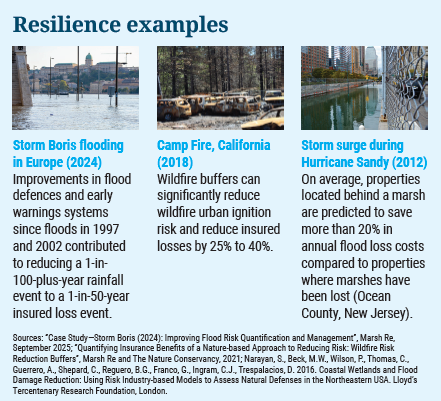
The good news is that resilience can translate to meaningful reductions in insured loss. Insurers can integrate resilience measures into risk modelling at the individual property level or at the community level. Examples of property-level resilience include Flood Re’s Build Back Better scheme in the UK, roof improvements in Florida and property-level wildfire resilience. Examples of community-level resilience are outlined opposite.
The Insurance Institute for Business & Home Safety (IBHS) is an independent, nonprofit scientific research and communications organisation supported by property insurers, reinsurers and affiliated companies. IBHS’s building safety research leads to real-world solutions for home and business owners, helping to create more resilient communities.
Aerial imagery and artificial intelligence offer an opportunity to efficiently consume large amounts of data on building attributes and resilience and incorporate this more effectively into risk pricing.
Through a better understanding of the impacts of resilience, we can ensure that resilience measures flow through the insurance value chain and thus promote sustainable insurance for future generations.